Lessons
Expressions & order of operations
An expression is a combination of numbers, variables, and operations. To evaluate consistently, everyone follows the same order — remembered as PEMDAS: Parentheses, Exponents, Multiplication/Division (left to right), Addition/Subtraction (left to right).
Multiplication and division have equal priority — you do whichever comes first reading left to right. Same for addition and subtraction.
Solving linear equations
A linear equation like 3x − 7 = 14 is a balance: whatever you do to one side, do to the other. The goal is to isolate x.
① Add 7 to both sides → 3x = 21
② Divide both sides by 3 → x = 7
③ Check: 3(7) − 7 = 14 ✓
Undo operations in reverse order: addition/subtraction first, then multiplication/division. Always check by substituting your answer back in.
Slope and linear functions
Slope measures how steep a line is — "rise over run":
m = (y₂ − y₁) / (x₂ − x₁)A line in slope-intercept form is y = mx + b, where m is the slope and b is the y-intercept (where the line crosses the y-axis).
Positive slope rises left-to-right, negative slope falls, zero slope is horizontal, and a vertical line's slope is undefined.
Quadratic equations
A quadratic has the form ax² + bx + c = 0. Any quadratic can be solved with the quadratic formula:
x = (−b ± √(b² − 4ac)) / 2aThe part under the root, b² − 4ac, is the discriminant. It tells you how many real solutions exist: positive → two real roots, zero → one repeated root, negative → two complex roots.
Exponents and their rules
An exponent tells you to multiply the base by itself: 2⁵ = 2×2×2×2×2 = 32.
| Rule | Example |
|---|---|
| aᵐ · aⁿ = aᵐ⁺ⁿ | 2³ · 2⁴ = 2⁷ |
| aᵐ / aⁿ = aᵐ⁻ⁿ | 3⁵ / 3² = 3³ |
| (aᵐ)ⁿ = aᵐⁿ | (2²)³ = 2⁶ |
| a⁰ = 1 | 99⁰ = 1 |
| a⁻ⁿ = 1/aⁿ | 2⁻³ = 1/8 |
| a^(1/n) = ⁿ√a | 16^(1/2) = 4 |
Geometry essentials
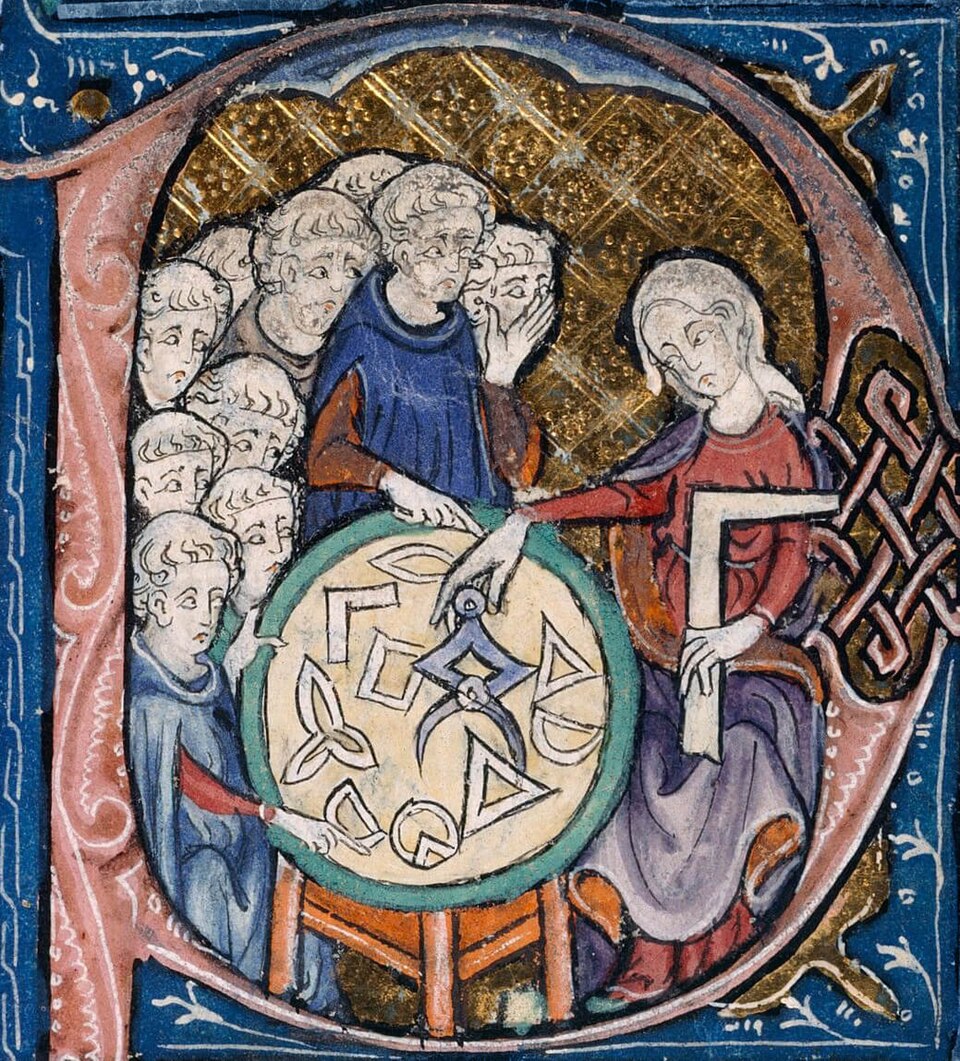
Triangles
Interior angles sum to 180°. For right triangles, the Pythagorean theorem connects the sides: a² + b² = c² where c is the hypotenuse.
Key area & volume formulas
| Shape | Formula |
|---|---|
| Triangle | A = ½bh |
| Circle | A = πr², C = 2πr |
| Rectangle | A = lw |
| Trapezoid | A = ½(b₁ + b₂)h |
| Sphere | V = (4/3)πr³ |
| Cylinder | V = πr²h |
Probability basics
Probability = (favorable outcomes) ÷ (total possible outcomes). It ranges from 0 (impossible) to 1 (certain).
Independent events: multiply probabilities. Two coin flips, P(two heads) = ½ × ½ = ¼.
Complement rule: P(not A) = 1 − P(A). If P(rain) = 0.2, then P(no rain) = 0.8.